
How CranioSacral Therapy Can Help with TMJ
Jaw pain can be surprisingly disruptive. What begins as mild tension can gradually contribute to headaches, neck pain, or a feeling of pressure around the ears. Eating, speaking, and yawning may become increasingly uncomfortable and interfere with daily life.
TMJ refers to the temporomandibular joint, the hinge near the opening of your ear canal that connects the lower jaw, or the mandible, to the temporal bone.
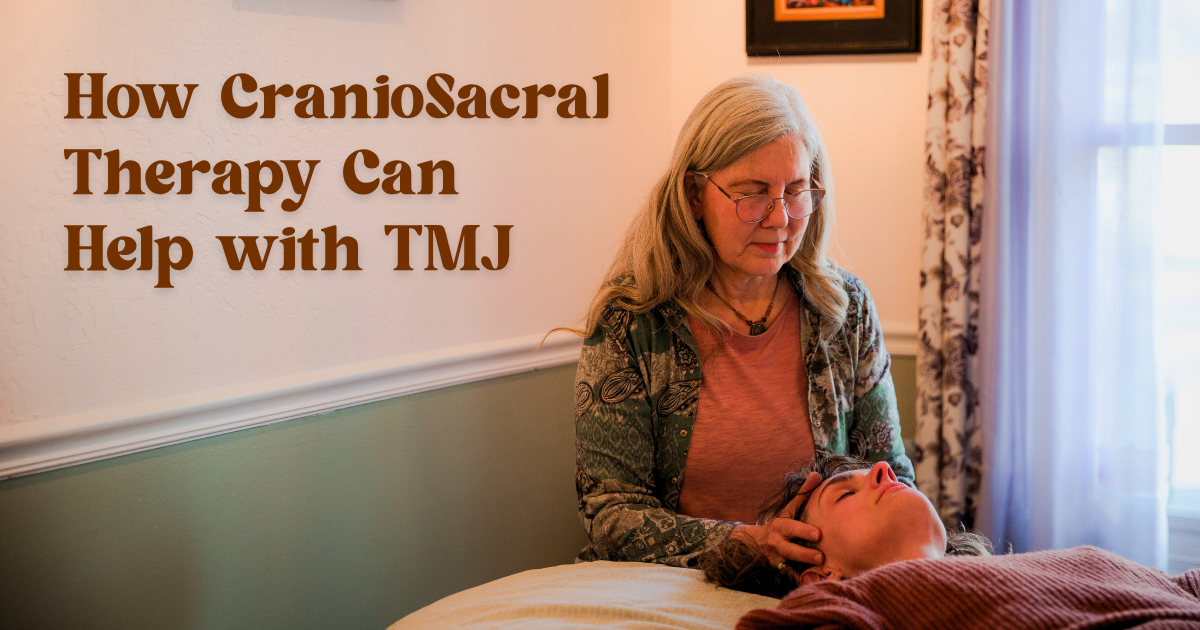
Anasuya Basil providing a CranioSacral Therapy Treatment in her Chico, California Office.
Feel your own TMJ
You can directly feel this joint when you put your index fingers where your ears attach to your face. Now open and close your mouth to feel this joint move. Any popping or grinding sensations?
This joint is designed to move smoothly, but stress, dental work, injury, clenching, and habitual patterns of tension may cause dysfunction.
Other TMJ Symptoms
Some people clench their teeth without even realizing they are doing it, particularly during sleep or periods of stress. Others notice clicking, stiffness, headaches, facial or neck tension, or discomfort that seems to extend to the pelvis.
Dental care, physical therapy, mouth guards, medication, and other approaches can be helpful depending on the cause of the problem. CranioSacral Therapy offers another way of working with jaw tension, particularly when the body seems to be holding more tension than can be addressed by focusing on the joint alone.
How CranioSacral Therapy Supports the Jaw
CranioSacral Therapy uses very light, attentive touch to work with the tissues and structures surrounding the brain and spinal cord. When working with someone experiencing jaw tension, I may work with the temporal and mandibular bones and other structures of the face and skull, as well as areas of the neck and spine that may be participating in the pattern.
The jaw does not function in isolation. It is connected through muscles, fascia, and movement patterns with the neck, shoulders, spine, and even the way we breathe.
When we are under stress we often unconsciously tighten the jaw, lift the shoulders, restrict the breath, or brace somewhere else in the body. Over time, these patterns can become so familiar that we no longer notice we are doing them.
CST does not involve forcing the jaw into a particular position. Instead, the intention is to give the body an opportunity to soften and release the patterns of strain.
Benefits of CranioSacral Therapy may include:
Less jaw pain or stiffness
Greater ease of movement
Less facial or neck tension
Fewer tension-related headaches
A greater awareness of clenching and holding patterns
Easier, more relaxed breathing
A greater sense of overall relaxation, flow, and alignment.
A Client with an Emotional Component to her TMJ pain
I remember one client particularly well because her experience illustrates how the body can hold tension for much longer than we realize.
She came to me after being referred by her physical therapist. She had been experiencing persistent jaw pain, and in her case there was also a significant emotional component. She had been through a difficult divorce as well as a car accident, and there was a sense that her body had remained in a state of bracing even after those experiences were behind her.
At the beginning of the session, I let her know that if emotions came up, she didn't need to hold them back. Nothing needed to be forced or analyzed; she could simply allow whatever was ready to move through.
As I worked with the structures around her jaw and face, including the temporal and zygomatic bones as well as the frontal and sphenoid bones, and the occiput where it meets the neck, I felt areas of tension soften. She responded with a deep breath and a sigh of relief. Then she allowed long suppressed tears to roll down her cheeks.
This is one of the beautiful things about CranioSacral Therapy. The work is not about making something happen. It is about creating the conditions in which the body can begin to let go of what it has been holding. We don't always need to know why it is holding on before we create enough safety and space for it to soften.
When she got up from the table, she immediately noticed a marked improvement in her jaw. There was considerably less discomfort and a sense of ease that had not been there when she arrived.
She returned for a couple more sessions, partly so we could give her body time to adjust to the change and partly so she could become more aware of her own tendency to hold tension in her jaw. As she became familiar with what a relaxed jaw actually felt like, she could begin to notice when she was slipping back into the old pattern of clenching or holding.
Not every case of TMJ has an emotional cause. Jaw pain can result from many different physical and structural factors. For this particular woman, there was clearly a connection between what she had lived through, how her nervous system had responded, and the tension she was carrying in her body.
Consider CST for Your Jaw
CranioSacral Therapy offers a quiet, non-invasive way of exploring a larger pattern. Sessions are slow and gentle, giving you time to notice what is happening in your body rather than asking your body to tolerate a forceful intervention.
If you're experiencing jaw tension, clicking, clenching, or related discomfort, CranioSacral Therapy may be worth exploring alongside appropriate dental, medical, or physical therapy care.
If you're in Chico, California, and would like to explore whether CranioSacral Therapy might be helpful for you, I welcome you to learn more or schedule a CST session with me.
You can also read my CranioSacral reviews and find my location here.
